Comparative Analysis of Quantum Models in the Prognosis of Cardiovascular Diseases
Article Sidebar
Main Article Content
Abstract
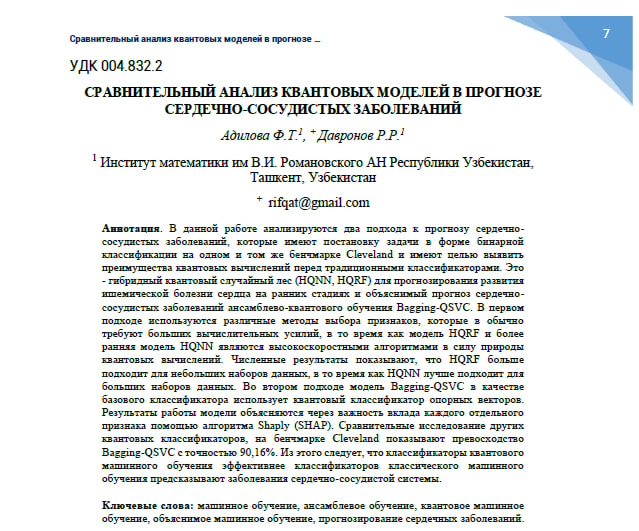
This paper analyzes two approaches to the prediction of cardiovascular diseases, which have a binary classification problem based on the same Cleveland benchmark and aim to identify the advantages of quantum computing over traditional classifiers. This is a hybrid quantum random forest (HQNN, HQRF) for predicting the development of coronary heart disease in the early stages and an explainable prediction of cardiovascular diseases by the ensemble-quantum learning of Bagging-QSVC. The first approach uses various feature selection methods, which usually require a lot of computational effort, while the HQRF model and the earlier HQNN model are high-speed algorithms due to the nature of quantum computing. Numerical results show that HQRF is more suitable for small datasets, while HQNN is better suited for large datasets. In the second approach, the Bagging-QSVC model uses a quantum support vector classifier as a basic classifier. The results of the model are explained through the importance of the contribution of each individual feature using the Shaply (SHAP) algorithm. Comparative studies of other quantum classifiers on the Cleveland benchmark show the superiority of Bagging-QSVC with an accuracy of 90.16%. It follows from this that quantum machine learning classifiers are more effective than classical machine learning classifiers in predicting diseases of the cardiovascular system.
Article Details

This work is licensed under a Creative Commons Attribution 4.0 International License.
References
K.E. Sleeman, M. de Brito, S. Etkind, K. Nkhoma, P. Guo, I.J. Higginson, B. Gomes, R. Harding, The escalating global burden of serious health-related suffering: projections to 2060 by world regions, age groups, and health conditions, The Lancet Global Health. 7 (2019) e883–e892. https://doi.org/10.1016/S2214-109X(19)30172-X.
X.-Y. Gao, A. Amin Ali, H. Shaban Hassan, E.M. Anwar. Improving the Accuracy for Analyzing Heart Diseases Prediction Based on the Ensemble Method, Complexity. 2021 (2021) 1–10. https://doi.org/10.1155/2021/6663455.
D.R. Thompson, C.F. Ski, J. Garside, F. Astin, A review of health-related quality of life patient-reported outcome measures in cardiovascular nursing, European Journal of Cardiovascular Nursing. 15 (2016) 114– 125. https://doi.org/10.1177/1474515116637980.
S. Saha, U.-G. Gerdtham, P. Johansson, Economic Evaluation of Lifestyle Interventions for Pre-venting Diabetes and Cardiovascular Diseases, IJERPH. 7 (2010) 3150–3195. https://doi.org/10.3390/ijerph7083150.
A. Timmis, P. Vardas, N. Townsend, A. Torbica, H. Katus, D. De Smedt, C.P. Gale, A.P. Maggioni, S.E. Petersen, R. Huculeci, D. Kazakiewicz, V. De Benito Rubio, B. Ignatiuk, Z. Raisi-Estabragh, A. Pawlak, E. Karagiannidis, R. Treskes, D. Gaita, J.F. Beltrame, A. McConnachie, I. Bardinet, I. Gra-ham, M. Flather, P. Elliott, E.A. Mossialos, F. Weidinger, S. Achenbach, European Society of Car-diology: cardiovascular disease statistics 2021, European Heart Journal. 43 (2022) 716–799. https://doi.org/10.1093/eurheartj/ehab892.
N.B. Oldridge, Economic burden of physical inactivity: healthcare costs associated with cardiovas-cular disease, European Journal of Cardiovascular Prevention & Rehabilitation. 15 (2008) 130–139. https://doi.org/10.1097/HJR.0b013e3282f19d42.
M.L. Adams, J. Grandpre, D.L. Katz, D. Shenson, Cognitive Impairment and Cardiovascular Dis-ease: A Comparison of Risk Factors, Disability, Quality of Life, and Access to Health Care, Public Health Rep. 135 (2020) 132–140. https://doi.org/10.1177/0033354919893030.
C. Melenotte, A. Silvin, A.-G. Goubet, I. Lahmar, A. Dubuisson, A. Zumla, D. Raoult, M. Merad, B. Gachot,C. Hénon, E. Solary, M. Fontenay, F. André, M. Maeurer, G. Ippolito, M. Piacentini, F.-S. Wang, F. Ginhoux,A. Marabelle, G. Kroemer, L. Derosa, L. Zitvogel, Immune responses during COVID-19 infection, OncoImmunology. 9 (2020) 1807836. https://doi.org/10.1080/2162402X.2020.1807836.
A. Krishnaswami, M.A. Steinman, P. Goyal, A.R. Zullo, T.S. Anderson, K.K. Birtcher, S.J. Goodlin, M.S. Maurer, K.P. Alexander, M.W. Rich, J. Tjia, Deprescribing in Older Adults With Cardiovascular Disease, Journal of the American College of Cardiology. 73 (2019) 2584–2595. https://doi.org/10.1016/j.jacc.2019.03.467.
C.R. González, M. López, AMP-activated protein kinase: ‘a cup of tea’ against cholesterol-induced neurotoxicity, J. Pathol. 222 (2010) 329–334. https://doi.org/10.1002/path.2778.
A. Mehmood, M. Iqbal, Z. Mehmood, A. Irtaza, M. Nawaz, T. Nazir, M. Masood, Prediction of Heart Disease Using Deep Convolutional Neural Networks, Arabian Journal for Science and Engineering. 46 (2021) 3409–3422. https://doi.org/10.1007/s13369-020-05105-1.
S. Kalayinia, F. Arjmand, M. Maleki, M. Malakootian, C.P. Singh, MicroRNAs: roles in cardiovas-cular development and disease, Cardiovascular Pathology. 50 (2021) 107296. https://doi.org/10.1016/j.carpath.2020.107296.
B. Simmons, Investigating Heart Disease Datasets and Building Predictive Models, Elizabeth City State University, 2021. https://libres.uncg.edu/ir/ecsu/f/Brandon_Simmons_Thesis-Final.pdf.
EIT Health and McKinsey & Company, “Transforming healthcare with AI,” 2020. [Online]. Avail-able https://eithealth.eu/wp-content/uploads/2020/03/EIT-Health-and-McKinsey_Transforming-Healthcare-with-AI.pdf.
K. Raza, Improving the prediction accuracy of heart disease with ensemble learning and majority voting rule. In: U-Healthcare Monitoring Systems, 1st. ed., vol. 1. New Delhi, India: Elsevier Inc, pp. 179–196, 2019.
IBM Institute for Business Value, “Exploring computing quantum use cases for healthcare,” 2020. https://www.ibm.com/thought-leadership/institute-business-value/report/exploring-quantum-financial#.
Hanif Heidari, Gerhard Hellstern, Murugappan Murugappan Heart Disease Detection using Quan-tum Computing and Partitioned Random Forest Methods arXiv:2208.08882v3 [quant-ph] https://doi.org/10.48550/arXiv.2208.08882.
Ghada Abdulsalam, Souham Meshoul, and Hadil Shaiba Explainable Heart Disease Prediction Us-ing Ensemble-Quantum Machine Learning Approach IASC, 2023, vol.36, no.1 Intelligent Automa-tion & Soft Computing DOI: 10.32604/iasc.2023.032262.
Y. Kumar, A. Koul, P. S. Sisodia, J. Shafi, K. Verma et al., “Heart failure detection using quantum-enhanced machine learning and traditional machine learning techniques for internet of artificially intelligent medical things,” Wireless Communications and Mobile Computing, vol. 2021, no. 1, pp. 1–16, 2021.
R. Narain, S. Saxena, A. Kumar, Cardiovascular Disease Prediction based on Physical Factors using Quantum Neural Network, 8 (2014).
A. Pérez-Salinas, Alba Cervera-Lierta, E. Gil-Fuster, J.I. Latorre, Data re-uploading for a universal quantum classifier, Quantum. 4 (2020) 226. https://doi.org/10.22331/q-2020-02-06-226.
G. Sergioli, R. Giuntini, H. Freytes, A new quantum approach to binary classification, PLoS ONE. 14 (2019) e0216224. https://doi.org/ 10.1371/journal.pone.0216224.
G. Hellstern, Analysis of a hybrid quantum network for classification tasks, IET Quantum Com-munication. 2 (2021) 153–159. https://doi.org/10.1049/qtc2.12017.
S. Alsubai, A. Alqahtani, A. Binbusayyis, M. Sha, A. Gumaei, S. Wang, Heart Failure Detection Using Instance Quantum Circuit Approach and Traditional Predictive Analysis, Mathematics. 11 (2023) 1467. https://doi.org/10.3390/math11061467.
S.I. Ayon, M.M. Islam, M.R. Hossain, Coronary Artery Heart Disease Prediction: A Comparative Study of Computational Intelligence Techniques, IETE Journal of Research. 0 (2020) 1–20.https://doi.org/10.1080/03772063.2020.1713916.
N.L. Fitriyani, M. Syafrudin, G. Alfian, J. Rhee, HDPM: An Effective Heart Disease Prediction Model for a Clinical Decision Support System, IEEE Access. 8 (2020) 133034–133050. https://doi.org/10.1109/ACCESS.2020.3010511.
M.S. Amin, Y.K. Chiam, K.D. Varathan, Identification of significant features and data mining tech-niques in predicting heart disease, Telematics and Informatics. 36 (2019) 82–93. https://doi.org/10.1016/j.tele.2018.11.007.
T. Karadeniz, G. Tokdemir, H.H. Maraş, Ensemble Methods for Heart Disease Prediction, New Generation Computing.39(2021)569–581. https://doi.org/10.1007/s00354-021-00124-4.
G.N. Ahmad, S. Ullah, A. Algethami, H. Fatima, S.Md.H. Akhter, Comparative Study of Optimum Medical Diagnosis of Human Heart Disease Using Machine Learning Technique With and Without Sequential Feature Selection, IEEE Access.10 (2022)23808–23828. https://doi.org/10.1109/ACCESS.2022.3153047.
M.G. El-Shafiey, A. Hagag, E.-S.A. El-Dahshan, M.A. Ismail, A hybrid GA and PSO optimized ap-proach for heart-disease prediction based on random forest, Multimed Tools Appl. 81 (2022) 18155–18179. https://doi.org/10.1007/s11042-022-12425-x.
A. Callison, N. Chancellor, Hybrid quantum-classical algorithms in the noisy intermediate-scale quantum era and beyond, Phys. Rev. A. 106 (2022) 010101. https://doi.org/10.1103/PhysRevA.106.010101.
C. B. C. Latha and S. C. Jeeva, “Improving the accuracy of prediction of heart disease risk based on ensemble classification techniques,” Informatics in Medicine Unlocked, vol. 16, pp. 1–9, 2019.
M. N. Uddin and R. K. Halder, “An ensemble method based multilayer dynamic system to predict cardiovascular disease using machine learning approach,” Informatics in Medicine Unlocked, vol. 24, no. 7, pp. 1–19, 2021.
D. Mehanović, Z. Mašetić and D. Kečo, “Prediction of heart diseases using majority voting ensemble method,” in IFMBE Proc., Banja Luka, Bosnia & Herzegovina, pp. 491–498, 2020.
X. Gao, A. A. Ali, H. S. Hassan and E. M. Anwar, “Improving the accuracy for analyzing heart dis-eases prediction based on the ensemble method,” Complexity, vol. 2021, pp. 1–10, 2021.
I. D. Mienye, Y. Sun and Z. Wang, “An improved ensemble learning approach for the prediction of heart disease risk,” Informatics in Medicine Unlocked, vol. 20, no. 8, pp. 1–5, 2020.
R. Das and A. Sengur, “Evaluation of ensemble methods for diagnosing of valvular heart disease,” Expert Systems with Applications, vol. 37, no. 7, pp. 5110–5115, 2010.
M. Schuld and F. Petruccione, “Quantum ensembles of quantum classifiers,” Scientific Reports, vol. 8, no. 1, pp.1–12, 2018.
S. Lundberg and S. Lee, “A Unified approach to interpreting model predictions,” in 31st Conf. on Neural Information Processing Systems (NIPS 2017), Long Beach, CA, USA, pp. 1–10, 2017.