Gomomorfik shifrlash algoritmlarining umumiy tahlili
Боковая панель статьи
Основное содержимое статьи
Аннотация
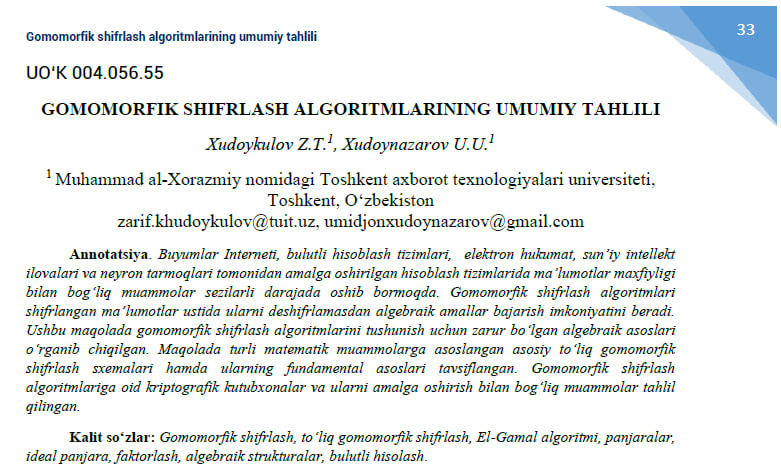
Buyumlar Interneti, bulutli hisoblash tizimlari, elektron hukumat, sun’iy intellekt ilovalari va neyron tarmoqlari tomonidan amalga oshirilgan hisoblash tizimlarida ma’lumotlar maxfiyligi bilan bog‘liq muammolar sezilarli darajada oshib bormoqda. Gomomorfik shifrlash algoritmlari shifrlangan ma’lumotlar ustida ularni deshifrlamasdan algebraik amallar bajarish imkoniyatini beradi. Ushbu maqolada gomomorfik shifrlash algoritmlarini tushunish uchun zarur bo‘lgan algebraik asoslari o‘rganib chiqilgan. Maqolada turli matematik muammolarga asoslangan asosiy to‘liq gomomorfik shifrlash sxemalari hamda ularning fundamental asoslari tavsiflangan. Gomomorfik shifrlash algoritmlariga oid kriptografik kutubxonalar va ularni amalga oshirish bilan bog‘liq muammolar tahlil qilingan.
Информация о статье

Это произведение доступно по лицензии Creative Commons «Attribution» («Атрибуция») 4.0 Всемирная.
Библиографические ссылки
O‘G‘Li, X. U. U. (2023). Parametrli algebraga asoslangan El-Gamal shifrlash algoritmlarini gomomorfik xususiyatini tadqiq etish. Al-Farg‘oniy avlodlari, 1(4), 153-157.
Rass, S., & Slamanig, D. (2013). Cryptography for security and privacy in cloud computing. Artech House.
Chatterjee, A., & Aung, K. M. M. (2019). Fully homomorphic encryption in real world applications. Singapore: Springer.
Jain, N., & Cherukuri, A. K. (2023). Revisiting Fully Homomorphic Encryption Schemes. arXiv preprint arXiv:2305.05904
Asante, G., Hayfron-Acquah, J. B., & Asante, M. (2021). Evolution of Homomorphic Encryption. International Journal of Computer Applications, 183(29), 37-40.
Fan, J., & Vercauteren, F. (2012). Somewhat practical fully homomorphic encryption. Cryptology ePrint Archive.
Sadi, M. (2020). Homomorphic encryption. In Emerging Topics in Hardware Security (pp. 281-307). Cham: Springer International Publishing.
Forouzan, B. A. (2007). Cryptography & network security. McGraw-Hill, Inc.
Wainakh, A. (2018). Homomorphic encryption for data security in cloud computing (Master’s thesis, Middle East Technical University).
Gentry, C. (2009, May). Fully homomorphic encryption using ideal lattices. In Proceedings of the forty-first annual ACM symposium on Theory of computing (pp. 169-178).
Koç, Ç. K., Özdemir, F., & Özger, Z. Ö. (2021). Partially Homomorphic Encryption (pp. 37-41). Springer.
Акбаров Давлатали Егиталиевич, Хасанов Пўлат Фаттохович, Хасанов Хислат Пўлатович, Ахмедова Ойдин Пўлатовна. (т.ф.д., профессор П.Ф. Хасанов таҳрири остида) “Криптографиянинг математик асослари” – ТОШКЕНТ 2010. 210 б
Benzekki, K., El Fergougui, A., & El Alaoui, A. E. B. (2016). A secure cloud computing architecture using homomorphic encryption. International Journal of Advanced Computer Science and Applications, 7(2).
Marcolla, C., Sucasas, V., Manzano, M., Bassoli, R., Fitzek, F. H., & Aaraj, N. (2022). Survey on fully homomorphic encryption, theory, and applications. Proceedings of the IEEE, 110(10), 1572-1609.
Brakerski, Z., & Vaikuntanathan, V. (2014). Efficient fully homomorphic encryption from (standard) LWE. SIAM Journal on computing, 43(2), 831-871.
Van Dijk, M., Gentry, C., Halevi, S., & Vaikuntanathan, V. (2010). Fully homomorphic encryption over the integers. In Advances in Cryptology–EUROCRYPT 2010: 29th Annual International Conference on the Theory and Applications of Cryptographic Techniques, French Riviera, May 30–June 3, 2010. Proceedings 29 (pp. 24-43). Springer Berlin Heidelberg.
Brakerski, Z., & Vaikuntanathan, V. (2011, August). Fully homomorphic encryption from ring-LWE and security for key dependent messages. In Annual cryptology conference (pp. 505-524). Berlin, Heidelberg: Springer Berlin Heidelberg.
Rivest, R. L., Adleman, L., & Dertouzos, M. L. (1978). On data banks and privacy homomorphisms. Foundations of secure computation, 4(11), 169-180.
Goldwasser, S., & Micali, S. (2019). Probabilistic encryption & how to play mental poker keeping secret all partial information. In Providing sound foundations for cryptography: on the work of Shafi Goldwasser and Silvio Micali (pp. 173-201).
ElGamal, T. (1985). A public key cryptosystem and a signature scheme based on discrete logarithms. IEEE transactions on information theory, 31(4), 469-472.
Benaloh, J. C. (1986, August). Secret sharing homomorphisms: Keeping shares of a secret secret. In Conference on the theory and application of cryptographic techniques (pp. 251-260). Berlin, Heidelberg: Springer Berlin Heidelberg.
Paillier, P. (1999, April). Public-key cryptosystems based on composite degree residuosity classes. In International conference on the theory and applications of cryptographic techniques (pp. 223-238). Berlin, Heidelberg: Springer Berlin Heidelberg.
Damgård, I., & Jurik, M. (2001). A generalisation, a simplification and some applications of Paillier's probabilistic public-key system. In Public Key Cryptography: 4th International Workshop on Practice and Theory in Public Key Cryptosystems, PKC 2001 Cheju Island, Korea, February 13–15, 2001 Proceedings 4 (pp. 119-136). Springer Berlin Heidelberg.
Boneh, D., Goh, E. J., & Nissim, K. (2005). Evaluating 2-DNF formulas on ciphertexts. In Theory of Cryptography: Second Theory of Cryptography Conference, TCC 2005, Cambridge, MA, USA, February 10-12, 2005. Proceedings 2 (pp. 325-341). Springer Berlin Heidelberg.
López-Alt, A., Tromer, E., & Vaikuntanathan, V. (2013). Multikey fully homomorphic encryption and on-the-fly multiparty computation. IACR Cryptology ePrint Archive, 2013.
Smart, N. P., & Vercauteren, F. (2010, May). Fully homomorphic encryption with relatively small key and ciphertext sizes. In International Workshop on Public Key Cryptography (pp. 420-443). Berlin, Heidelberg: Springer Berlin Heidelberg.